Archaeology : Architecture : Art : Cold War : Curiosities : Design : Eccentricities : Ekco : Engineering : Industrial Heritage : Military : Petroliana : Photography : Shed Wonders : Transporter Bridges : Vintage Technology
26 May 2013
AD37, Anno Domini 1936
The Ekco AD37, an upright table model operating on AC/DC, was released in March 1936, price £8.18s.6d in the walnut Bakelite pictured, and £9.3s.6d in a black Bakelite and ivory urea formaldehyde version. The set was manufactured at both Ekco's principal factory in Southend-on-Sea, and at their small manufacturing and distribution operation in Haren, near Brussels, Belgium. This last was a means to mitigate the effect of continental import duties, levied by weight, but closed in 1937 for reasons of economics. A battery version (B37) was also available, as was a wooden stand.
Labels:
Design,
Ekco,
Vintage Technology
19 May 2013
Triumph - German First & Last
Held at the Heritage Motor Centre, Gaydon, STAR90 - the Standard Triumph Anniversary Rally - celebrated 90 years of Triumph and 110 years of Standard, and attracted hundreds of cars of both marques.
Reginald Walter Maudsley founded the Standard Motor Company in 1903, building the single cylinder Motor Victoria. Triumph was founded earlier, in 1887, by German Siegfried Bettmann, manufacturing bicycles, then motorbikes from 1902, but didn't produce its first car, the 10/20, until 1923. The Triumph Super Seven (above), was built between 1927 and 1934.
The Dolomite appeared in 1934, Triumph having decided to cease making small cars and concentrate instead on the luxury market. All 1930s Dolomites, other than the Straight 8, feature Walter Belgrove's distinctive waterfall grille.
Triumph remained independent until 1939, when Standard bought it out of receivership. The company addressed itself anew to the market for small cars, building between 1949 and 1953 the Triumph Mayflower (above), which shares some design cues with the larger contemporaneous 'razor edge' Triumphs such as the Renown.
In 1953 Standard introduced the Eight, a four-door saloon with a new 803cc 'small car' overhead valve engine. The following year saw the launch of the Ten, the SC engine increased to 1,147cc. This engine, increased next to 1,296cc and finally to 1,493cc, was built right up until 1980.
1953 also saw the introduction of the first Triumph TR, Standard having determined to compete in the market for sports cars. The model evolved from TR2 through to TR6, with a change to a six cylinder made in 1967. The all-new TR7 was introduced in 1974, and survived until 1981. Its last incarnation was known as a TR8 - a TR7 with a Rover V8 engine (above).
The Dolomite appeared in 1934, Triumph having decided to cease making small cars and concentrate instead on the luxury market. All 1930s Dolomites, other than the Straight 8, feature Walter Belgrove's distinctive waterfall grille.
Triumph remained independent until 1939, when Standard bought it out of receivership. The company addressed itself anew to the market for small cars, building between 1949 and 1953 the Triumph Mayflower (above), which shares some design cues with the larger contemporaneous 'razor edge' Triumphs such as the Renown.
In 1953 Standard introduced the Eight, a four-door saloon with a new 803cc 'small car' overhead valve engine. The following year saw the launch of the Ten, the SC engine increased to 1,147cc. This engine, increased next to 1,296cc and finally to 1,493cc, was built right up until 1980.
1953 also saw the introduction of the first Triumph TR, Standard having determined to compete in the market for sports cars. The model evolved from TR2 through to TR6, with a change to a six cylinder made in 1967. The all-new TR7 was introduced in 1974, and survived until 1981. Its last incarnation was known as a TR8 - a TR7 with a Rover V8 engine (above).
By the late 1950s, Triumph had greater brand greater recognition than Standard. What had been the Standard Vanguard's segment of the market was met by the Triumph 2000 (above), designed by Michelotti and introduced in 1963. This was produced through to 1977, alongside more powerful versions, the Triumph 2500 and Triumph 2.5 PI (petrol injection).
Michelotti also designed the Triumph Stag, revising a pre-production Triumph 2000 to form a four-seat convertible that was available between 1970 and 1978. The Stag (above) was intended to compete with the Mercedes SLs, and despite its temperamental 3.5 V8 power plant was very successful in the States.
Designed as successor to the Triumph Herald and Triumph 1300, the new Dolomite was introduced in 1972, one later version being the 1500 SE (above), which used the final incarnation of the SC engine that had started life in 1953. The final Triumph was the Acclaim, essentially a Honda, built until 1984. The Triumph brand is currently owned by BMW.
Labels:
Design,
Engineering
18 May 2013
Mary Arden's Farm - Confusion's Masterpiece
What is now presented as Mary Arden's Farm, the childhood home of Shakespeare's mother, is actually an amalgam of the house in which Mary was indeed brought up - Mary Arden's House - and the neighbouring farm of the Palmer family.
The farm, located in Wilmcote, about three miles outside Stratford-upon-Avon, would by the standards of the 1570s have been an affluent one. Its own cider mill and stone dovecote were all part of the huge enterprise needed to sustain the farm's workers.
The Shakespeare Birthplace Trust had for many years preserved as Mary Arden's House the farmhouse discovered, in 2000, to have in fact belonged to Adam Palmer, and now known as Palmer's Farm (below).
The Trust had however bought, back in 1968, the adjoining property, then known as Glebe Farm, to prevent redevelopment next to what had been thought of Mary Arden's House. Glebe Farm is now correctly identified as the Ardens' house.
Labels:
Architecture,
Art
17 May 2013
Lorenz & Colossus
At Bletchley Park is displayed a working replica of the Bombe machines used in the decryption of WWII Germany's signals, encoded through Enigma machines. On the same site is the National Museum of Computing, home to a working replica of Colossus, the world's first electronic computer, used to break Lorenz-enciphered messages. Lorenz was used by Germany's Army High Command to communicate with its Group Commanders, as it provided greater security than Enigma.
Lorenz, ultimately emulated by a machine largely made of telephone exchange components and known as Tunny by the Bletchley code-breakers, used twelve rotors, compared with the three of a standard Enigma machine. It was brought into service in 1941. A Lorenz attachment fitted to a conventional teleprinter added, to the standard five impulses used for each letter - the equivalent of today's 1s and 0s - the five impulses for each letter of the key, automatically generated by the machine. There was a pair of wheels for each impulse, plus two motor wheels that added a degree of randomness.
The coded messages, known as fish at Bletchley, each fish name being one of the communication routes, were transmitted by radio and fed straight into a receiving Lorenz machine. By addition of the same key, this produced teleprinter output in plain text. The key changed with each message, as opposed to Enigma's diurnal key changes. There were 16,000,000,000,000,000,000 possible initial wheel settings. The British could intercept the coded messages, but not break them.
A machine - known as Heath Robinson - was designed by Dr Max Newman to determine the Lorenz starting rotor positions, but this was slow. Post Office engineer Tommy Flowers was brought in. Within just nine months he had designed and built the Colossus prototype, which made use of punched tape and optical reader input, and 1,500 thermionic valves. This was operational by December 1943. The coded message was run again and again, each time against a different starting position for a pair of wheels, searching for an output pattern that, based on carefully calculated probabilities, indicated when the correct positions had been determined.
By the end of the war there were ten Colossus Mark IIs at Bletchley, each using 2,500 valves. Colossus was kept secret until 1975, the mechanical assembly drawings having been deliberately destroyed in 1960. Between 1993 and 2008 Tony Sale, ex-MI5 principal scientific officer, led a project to rebuild a Mark II Colossus, with just eight photographs of 1945 and a few fragmentary circuit diagrams, thankfully kept illegally by some engineers, as source material. The rebuilt machine stands where Colossus No. 9 stood during the war.
Lorenz, ultimately emulated by a machine largely made of telephone exchange components and known as Tunny by the Bletchley code-breakers, used twelve rotors, compared with the three of a standard Enigma machine. It was brought into service in 1941. A Lorenz attachment fitted to a conventional teleprinter added, to the standard five impulses used for each letter - the equivalent of today's 1s and 0s - the five impulses for each letter of the key, automatically generated by the machine. There was a pair of wheels for each impulse, plus two motor wheels that added a degree of randomness.
The coded messages, known as fish at Bletchley, each fish name being one of the communication routes, were transmitted by radio and fed straight into a receiving Lorenz machine. By addition of the same key, this produced teleprinter output in plain text. The key changed with each message, as opposed to Enigma's diurnal key changes. There were 16,000,000,000,000,000,000 possible initial wheel settings. The British could intercept the coded messages, but not break them.
It was not until August 1941, when a long message was sent twice, using the same initial wheel settings, by a Lorenz operator, who in the second message also utilized various abbreviations, that a way into the fish was found. Cryptanalyst John Tiltman took ten days to decipher both messages, and Bill Tutte deduced mathematically how Lorenz worked. From mid-1942 Lorenz-encoded messages could be decoded, but an automated solution was essential to speed the process of determining the ever-changing key.
A machine - known as Heath Robinson - was designed by Dr Max Newman to determine the Lorenz starting rotor positions, but this was slow. Post Office engineer Tommy Flowers was brought in. Within just nine months he had designed and built the Colossus prototype, which made use of punched tape and optical reader input, and 1,500 thermionic valves. This was operational by December 1943. The coded message was run again and again, each time against a different starting position for a pair of wheels, searching for an output pattern that, based on carefully calculated probabilities, indicated when the correct positions had been determined.
By the end of the war there were ten Colossus Mark IIs at Bletchley, each using 2,500 valves. Colossus was kept secret until 1975, the mechanical assembly drawings having been deliberately destroyed in 1960. Between 1993 and 2008 Tony Sale, ex-MI5 principal scientific officer, led a project to rebuild a Mark II Colossus, with just eight photographs of 1945 and a few fragmentary circuit diagrams, thankfully kept illegally by some engineers, as source material. The rebuilt machine stands where Colossus No. 9 stood during the war.
05 May 2013
April Fools' Car Show - in May
The 2013 April Fools' Car Show, again hosted at Canal Central, Maesbury Marsh, was rescheduled to May due to snow on 1 April. The sun brought out over fifty vehicles, of great diversity. Particularly cute was a 1971 VW campervan, towing a Heinkel Trojan bubble car, in Cadbury's trademarked (for chocolate) purple.
There were some real rarities, including a Morris Marina 1.3 estate, a lovely Peugeot 304S cabriolet, and a pair of steam vehicles - a Stanley steam car and a Super-Sentinel DG4 steam waggon, built in Shrewsbury in 1931.
Exotica included a unique special-edition Bentley Arnage Mulliner Black Label, a Ferrari F430, and the pair of gentlemen's expresses pictured above - an Aston Martin DB5 and a Jensen FF (Ferguson Formula), the first road-going production car equipped with four wheel drive.
Labels:
Shed Wonders
29 April 2013
Echo of an Ekco
In 1931 Ekco introduced the RS2 wireless, available in AC and DC versions, in a cathedral-style Bakelite cabinet by the company's Head of Design, J.K. White. In February 1932 a major fire at Ekco's Southend-on-Sea factory destroyed, amongst other things, the R&D facilities and, with these, the prototypes for 1932/33.
In 1932 Ekco brought out the pictured M23 (AC), also available in a DC version, with medium-wave and long-wave, using the same cabinet as the RS2, but with concentric knobs to provide for the greater number of controls. The new model, using a prior year's cabinet design, was unpopular and had to be heavily discounted, and Ekco only just avoided bankruptcy. The standard cabinet colour was walnut (pictured), but mahogany and dark jade could be had as special orders.
Labels:
Design,
Ekco,
Vintage Technology
20 April 2013
Cambrian Heritage Railways - Steam
Cambrian Heritage Railways is making steady progress against its aim to ultimately operate trains between Gobowen, where there is a mainline station, and both Llynclys Junction and Blodwel, the latter along the Tanat Valley.
Prior to formation of the Cambrian Railways Society, one part of what is now CHR, the last passenger train from Oswestry station ran in 1968. There is an interesting little museum in the old goods shed, around which is stored a selection of parts, large and small, to be used in the CHR's enterprise.
This currently includes short sections of operational track alongside the station, and between Llynclys and Penygarreg Halt, at either end of which have been constructed new buildings in keeping with the style of Cambrian Railways.
Cambrian Heritage Railways - Diesel, Petrol & Tar
Cambrian Heritage Railways each year runs a transport festival in Oswestry. Among the commercial vehicles on display were a 1962 ERF (Edwin Richard Foden) KV and a 1954 Fordson Thames ET6.
At the other end of the size scale was a Paul Smith special edition Mini, registration P5 MNY. Just 300 were made for the UK, from 1998, all in Paul Smith Blue. The one on show tows a fold-down camper trailer, fitted out to match the car.
A 1961 Leyland Tiger Cub bus, ex Trent Buses, now in Tanat Valley colours, ran from Oswestry to Cambrian Heritage Railways' site at Llynclys.
At this last the new-built station and platform has been decorated with vintage enamel signs. One such is clearly from, depending upon one's view, an age either more innocent, or more misleading, or perhaps both.
Labels:
Engineering,
Shed Wonders
14 April 2013
White Nancy
Built by John Gaskell in 1817 atop the Saddle of Kerridge, above Bollington, Cheshire, White Nancy is a rendered sandstone rubble folly that commemorates the Battle of Waterloo. There was originally an entrance, to a single room in which perimeter stone benches were ranged about a round stone table in the centre; but the doorway is now blocked. Grade II listed, the folly, about 18 feet tall, is reputedly named after the principal horse used to haul the building materials to the site. However, its colour must play a part in its name: the folly was not painted until about 1925, since when it has generally been white.
Labels:
Architecture,
Curiosities
11 April 2013
Hoover, Damned
The Hoover company's UK washing machine factory was established in Pentrebach, just south of Merthyr Tydfil, in 1948. Hoover's British division ran a disastrous promotional scheme in 1992, promising free airline tickets to the USA for customers spending over £100, far less than the cost of the tickets. It was overwhelmed by demand, tried to duck its contractual obligations, was sued in 1994, and by 1998 had lost some £50m on the deal. Candy took over.
The Merthyr plant, (in)famous for also manufacturing the Sinclair C5 - "Built by Hoover, driven by suckers" was a common joke - ceased production in 2009. Although the Hoover brand is very much alive and kicking, and hoovering synonymous with vacuuming despite the rise of Dyson (by whom Hoover were successfully sued for patent infringement), this was an ignominious end for the UK production operation.
Labels:
Architecture,
Design,
Engineering
31 March 2013
Soixante-Neuf, 1938-style
The Ekco all-wave AW69 (alternating current) was introduced in 1938, and boasted short-, medium- and long-wave bands. It's what's known as an upright table model, though at 22 inches high it would have dominated many an average room of the 1930s. The expansive speaker grille cloth has been replaced. The set was also available in AC/DC (UAW69) and battery (BAW69) forms.
Labels:
Design,
Ekco,
Vintage Technology
24 March 2013
Polar(oid)
Shot on a Polaroid 636 CloseUp instant camera, introduced 1996, using out-of-date PX 680 Color Shade film by The Impossible Project, which manufactures instant film at the ex-Polaroid factory in Enschede, the Netherlands.
Labels:
Photography,
Vintage Technology
21 March 2013
Hemlock Hillock, Nottingham
Labels:
Archaeology,
Curiosities,
Nature
18 March 2013
Joule's Energy
The pale ale that later became Joule's was first brewed by Augustinian monks, in Stone, Staffordshire, from the twelfth century, each barrel 'blessed' and marked with a cross. Joule's later adopted the priory's recipe, and registered the red cross as a trademark - the sixth oldest beer mark in the world. The mark is still used, as it was in use prior to the symbol's adoption by the International Red Cross. (The first trademark registered in Britain was the Bass red triangle, in 1876; the second the Bass red diamond.)
The first Joule-named brewery was in Salford, from the mid-1700s, the second in Stone, from 1779. Bass Charrington acquired Joule's in the early 1970s, demolished the brewery, and dropped the brand. 36 years later, a new Joule's was reformed, the independent buying the brand, brewing notes and methods, and yeast, of the original Joule's from Molson Coors, owners of Bass and its various brands.
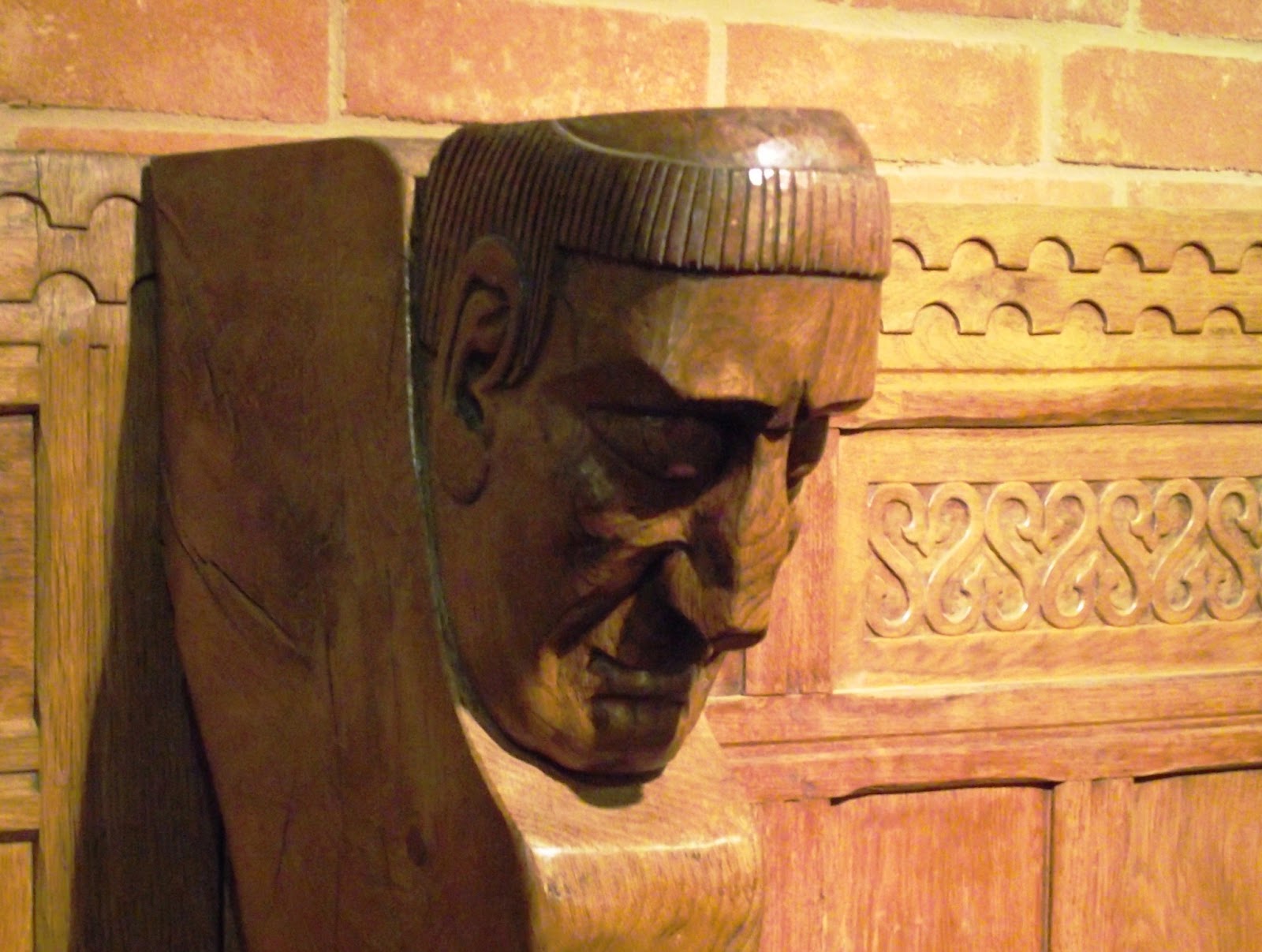
The new brewery was built next to the Red Lion, a Market Drayton pub of the 16th century. It draws its water from the Market Drayton aquifer, the same as was used by the Stone brewery. There are three beers - Blonde, the original Joule's Pale Ale, and Slumbering Monk, named for a feature of the panelling that graces part of the brewery tap. This was carved by Robert 'Mouseman' Thompson, and came from the Bradford boardroom of Grattan's, where it had been installed in 1931.
09 March 2013
Triumph Carledo
Labels:
Engineering,
Racing,
Shed Wonders
07 March 2013
Angels With Dirty Faces
In response to crowded churchyards and urban population increase, private enterprise developed new cemeteries from the 1830s. The cholera epidemics of early that decade, and in the late 1840s, led to the introduction of the Burial Acts, which established much-needed public cemeteries in all major urban areas of Britain.
Brandwood End Cemetery, near Kings Heath, five miles south of Birmingham city centre, was laid out on what had previously been farmland, acquired in 1895. It was opened in 1899, thereby just squeaking into being a Victorian cemetery, and is laid out in the classic pattern for these - a central, tree-lined drive, with pathways at right angles to this.
The cemetery has a Grade II listing, yet the twin mortuary chapels are in a state of serious disrepair. Built of red brick and terracotta, these were designed by Brewin Holmes, and are essentially Gothic, although boast Art Nouveau touches.
The ever divisive nature of religion is reflected in the fact that one chapel was Anglican and the other Non-Conformist. However, the two chapels are conjoined by a common porte-cochère, topped by a tower and spire. And, of course, everyone ended up in the same earth.
Although thought of as classically Victorian, the angels that grace a number of the graves nearest to the mortuary chapels are, in fact, Edwardian, and are generally of Italian marble.
Labels:
Architecture,
Art,
Photography
04 March 2013
01 March 2013
From Little Acorns
Rising at just over 2,000 feet on Plynlimon, the highest point in the Cambrian Mountains, the Severn - Hafren in Welsh - is, at 220 miles, the longest British river.
It is difficult to conceive, from its upper reaches - the Blaen Hafren falls pictured above is close to the source - that it is also, by its end, the river of greatest discharge in England and Wales.

The river's drainage basin covers over 4,400 square miles, and is extensively studied by hydrologists, who have installed numerous measuring weirs. The first waterfall of note is Severn Break-Its-Neck, just a couple of miles from the source.
It is difficult to conceive, from its upper reaches - the Blaen Hafren falls pictured above is close to the source - that it is also, by its end, the river of greatest discharge in England and Wales.
Labels:
Engineering,
Photography