31 March 2013

Soixante-Neuf, 1938-style


The Ekco all-wave AW69 (alternating current) was introduced in 1938, and boasted short-, medium- and long-wave bands. It's what's known as an upright table model, though at 22 inches high it would have dominated many an average room of the 1930s. The expansive speaker grille cloth has been replaced. The set was also available in AC/DC (UAW69) and battery (BAW69) forms.

24 March 2013

Polar(oid)


Shot on a Polaroid 636 CloseUp instant camera, introduced 1996, using out-of-date PX 680 Color Shade film by The Impossible Project, which manufactures instant film at the ex-Polaroid factory in Enschede, the Netherlands.

21 March 2013

Hemlock Hillock, Nottingham


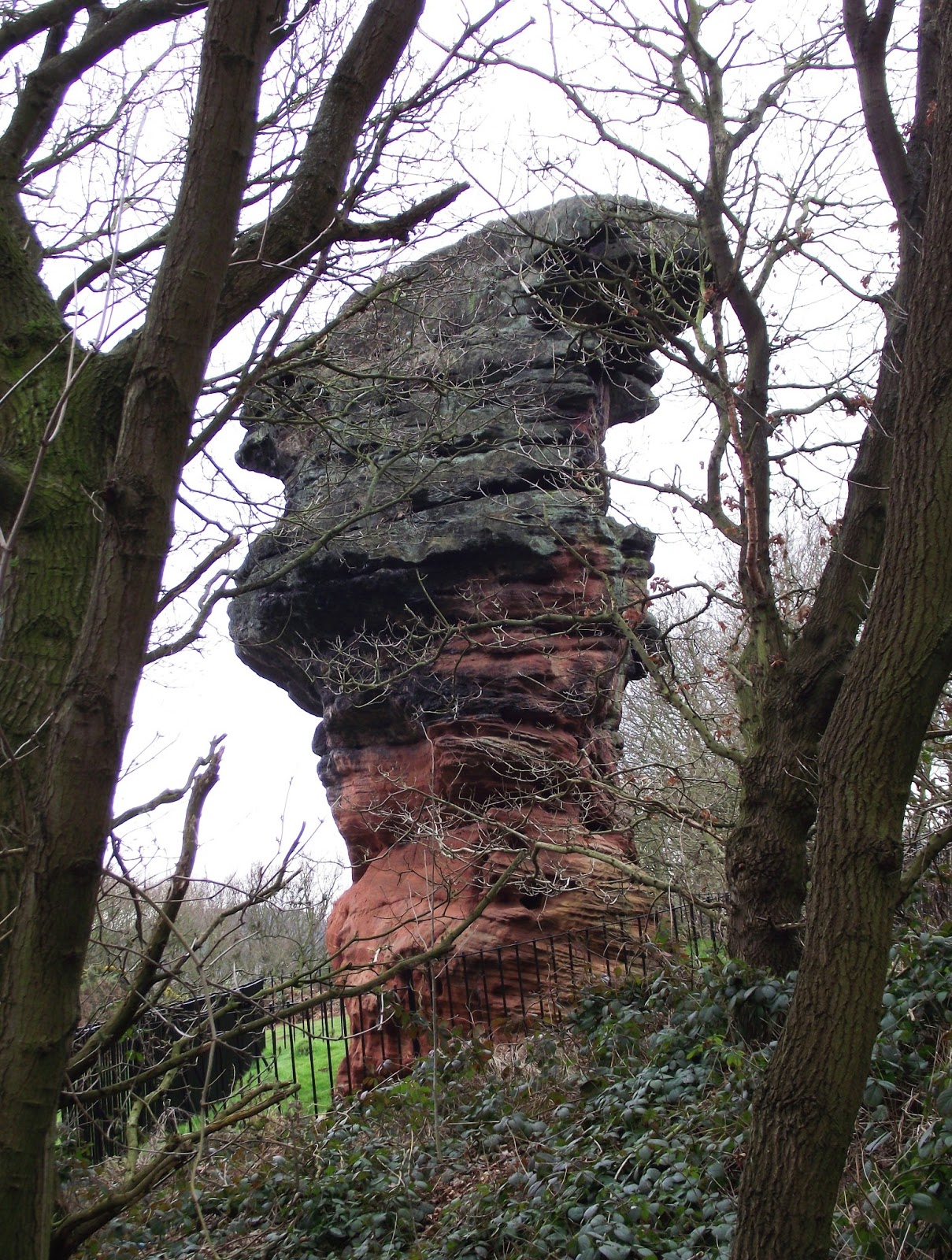
The Hemlock Stone is a pillar of Nottingham Castle sandstone. Such rock is normally weakly cemented, but this outcrop is firmly held together by the mineral barytes, which increases in proportion towards the top of the pillar. Over the last 20 million years the softer overlying and surrounding sediments have been eroded, and the barytes-rich 'cap' has protected the strata beneath it. There is a fanciful story about the stone featuring in ancient Celtic druidic rituals, but no evidence.

18 March 2013

Joule's Energy


The pale ale that later became Joule's was first brewed by Augustinian monks, in Stone, Staffordshire, from the twelfth century, each barrel 'blessed' and marked with a cross. Joule's later adopted the priory's recipe, and registered the red cross as a trademark - the sixth oldest beer mark in the world. The mark is still used, as it was in use prior to the symbol's adoption by the International Red Cross. (The first trademark registered in Britain was the Bass red triangle, in 1876; the second the Bass red diamond.)


The first Joule-named brewery was in Salford, from the mid-1700s, the second in Stone, from 1779. Bass Charrington acquired Joule's in the early 1970s, demolished the brewery, and dropped the brand. 36 years later, a new Joule's was reformed, the independent buying the brand, brewing notes and methods, and yeast, of the original Joule's from Molson Coors, owners of Bass and its various brands.


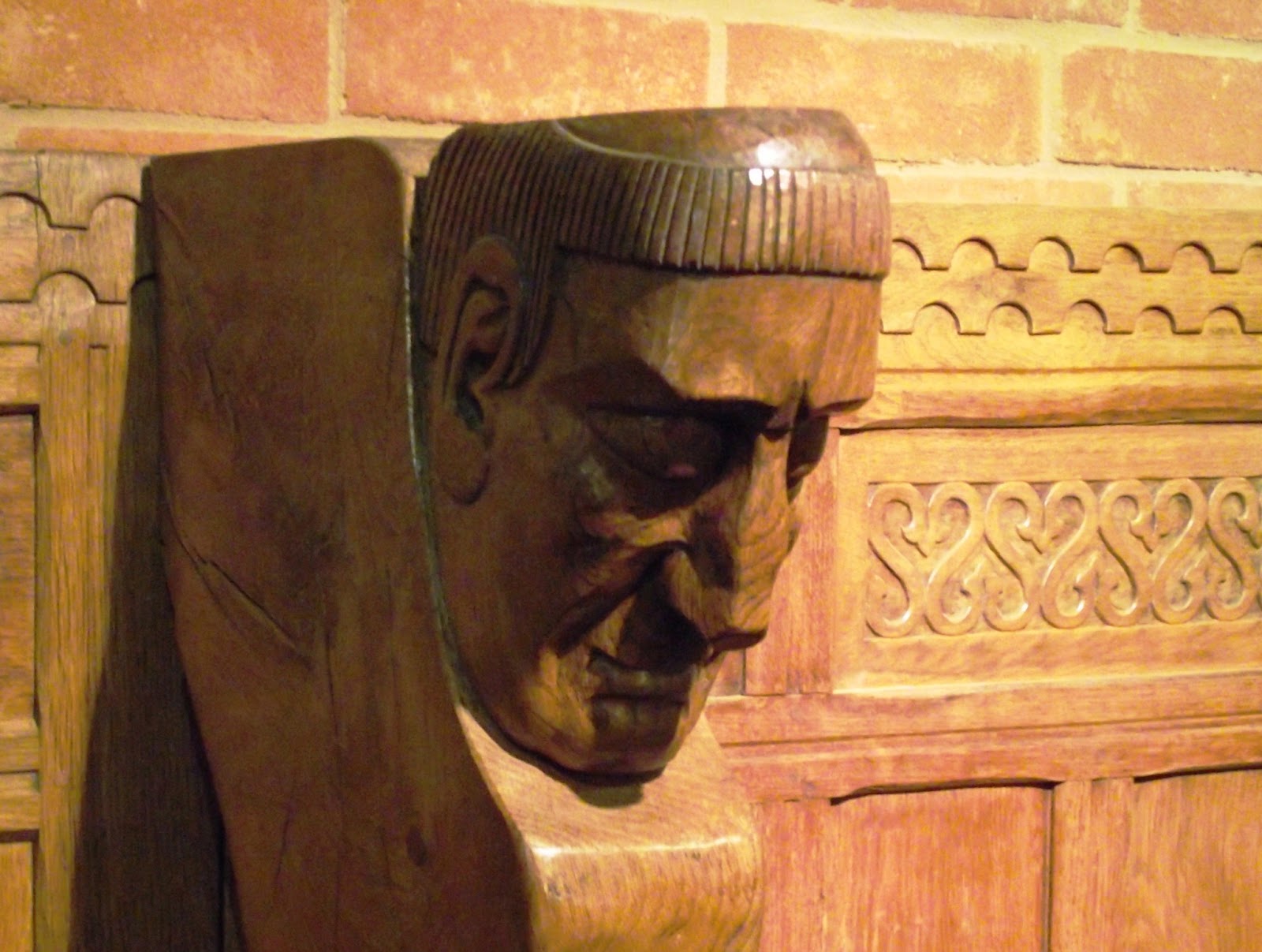
The new brewery was built next to the Red Lion, a Market Drayton pub of the 16th century. It draws its water from the Market Drayton aquifer, the same as was used by the Stone brewery. There are three beers - Blonde, the original Joule's Pale Ale, and Slumbering Monk, named for a feature of the panelling that graces part of the brewery tap. This was carved by Robert 'Mouseman' Thompson, and came from the Bradford boardroom of Grattan's, where it had been installed in 1931.

09 March 2013

Triumph Carledo

A 1974 Triumph Toledo, fitted with an injected two litre Vauxhall Carlton SRi engine, driving through a Vauxhall Omega gearbox. Finished in Carmine Red, and sitting on MGF wheels. Not to be taken on lightly.

07 March 2013

Angels With Dirty Faces


In response to crowded churchyards and urban population increase, private enterprise developed new cemeteries from the 1830s. The cholera epidemics of early that decade, and in the late 1840s, led to the introduction of the Burial Acts, which established much-needed public cemeteries in all major urban areas of Britain.


Brandwood End Cemetery, near Kings Heath, five miles south of Birmingham city centre, was laid out on what had previously been farmland, acquired in 1895. It was opened in 1899, thereby just squeaking into being a Victorian cemetery, and is laid out in the classic pattern for these - a central, tree-lined drive, with pathways at right angles to this.


The cemetery has a Grade II listing, yet the twin mortuary chapels are in a state of serious disrepair. Built of red brick and terracotta, these were designed by Brewin Holmes, and are essentially Gothic, although boast Art Nouveau touches.


The ever divisive nature of religion is reflected in the fact that one chapel was Anglican and the other Non-Conformist. However, the two chapels are conjoined by a common porte-cochère, topped by a tower and spire. And, of course, everyone ended up in the same earth.


Although thought of as classically Victorian, the angels that grace a number of the graves nearest to the mortuary chapels are, in fact, Edwardian, and are generally of Italian marble.

04 March 2013

Karan Anne Porter


Thursday 4 March 1965 to Wednesday 4 February 2009.
Photograph: Lancaster, 1987.

01 March 2013

From Little Acorns

Rising at just over 2,000 feet on Plynlimon, the highest point in the Cambrian Mountains, the Severn - Hafren in Welsh - is, at 220 miles, the longest British river.


It is difficult to conceive, from its upper reaches - the Blaen Hafren falls pictured above is close to the source - that it is also, by its end, the river of greatest discharge in England and Wales.


The river's drainage basin covers over 4,400 square miles, and is extensively studied by hydrologists, who have installed numerous measuring weirs. The first waterfall of note is Severn Break-Its-Neck, just a couple of miles from the source.

21 February 2013

Devil's Bridge, Ceredigion


At Pontarfynach are three famous bridges piled atop each other, spanning a tributary of the Rheidol - the Mynach. The lowest bridge is of the twelfth, or possibly even the eleventh, century; and was supposedly built by the Devil, the ravine through which the Mynach passes being too challenging for human builders - the river drops 300 feet in five leaps.


The folk tale has it that Old Nick bargained with an old woman, who needed to get to the other side of the river to recover a cow, that he would build the impossible bridge overnight in exchange for the soul of the first living creature to cross it in the morning. The bridge was built but Beelzebub was outsmarted: the old woman threw a loaf across the river and her dog ran after it, crossing the bridge. The dog presumably became a Hound of Hell.


The middle bridge, of stone, as is the lowest, was built in 1753. The uppermost bridge, which today carries the road over the river, is of iron, built 1901. The footbridge pictured is of 1867. Near one end of the road bridge stands an Automobile Association box. There were once over 1,000 of these on Britain's trunk roads, the first introduced in 1911, in Ashtead, Surrey.


Initially accommodating AA patrolmen, the boxes were later provided with a 'phone, such that an AA member, armed with his or her box key, could call for assistance and shelter from the weather. The boxes were kitted out with maps and a fire extinguisher, and were lit at night. They were phased out through the 1970s and 1980s. The AA closed its private 'phone network in 2002, and no more than a dozen boxes are understood to remain outwith museums.

18 February 2013

Analogue, the New Digital

Digital cameras are now ubiquitous, and everyone with a mobile 'phone is a David Bailey. Against every trend however there is a counter-trend, and that against digital is known as lomography. This is both a community, centred around the Lomographic Society International, founded in Vienna in 1992; and a brand name, of Lomographische AG, distributor outside of the old USSR of the originally cheap Lomo LC-A camera made in St Petersburg from the early 1980s.


Lomography has become fashionable and 'lomo' cameras thus expensive: the all-plastic Diana of the early 1960s, available in 120mm and 35mm film formats, was made by the Great Wall Plastic Factory, Kowloon, and often given away as a novelty; the modern copy costs £80 new. Plastic cameras can though still be found cheap, as in the case of this unbranded 35mm made in the Republic of China (Taiwan). No batteries, no reflex mirror, a fixed-focus plastic lens, f-stops of only 6, 8, 11 and 16, and a single shutter speed.

22 January 2013

Stoneleigh Abbey Panorama

The Cistercian abbey at Stoneleigh was founded in 1154, dissolved in 1535, and sold to Sir Thomas Leigh in 1561. The house remained in the hands of the Leigh family right up to 1996. The grand West Wing, by Francis Smith of Warwick, was built between 1720 and 1726, under the patronage of Edward, 3rd Lord Leigh.


In 1809 Humphrey Repton developed plans for the park. Although the works ultimately undertaken did not deliver the whole of Repton’s plans, the course of the River Avon was altered to provide a lake to the south of the house. This formality of this and the West Wing acts as a foil to the remaining mediaeval buildings.

(Left click on the photographs to view these full screen.)

25 December 2012

Another Place


Made of solid cast iron, the 100 life-size sculptures that go to make up Another Place are from a mould of the body of the artist, Antony Gormley, famous for the Angel of the North, in Gateshead, Tyne and Wear. Mounted on foundations driven ten feet into the sand, they are spread along nearly two miles of Crosby beach, north of Liverpool.


The installation is over half a mile deep, yet all 100 sculptures are completely submerged at the very highest tides. The work, now permanently at Crosby, was previously displayed in Cuxhaven in Germany, Stavanger in Norway, and De Panne in Belgium, all coastal sites.

Gormley: "The seaside is a good place to do this. Here time is tested by tide, architecture by the elements, and the prevalence of sky seems to question the earth's substance. In this work human life is tested against planetary time. This sculpture exposes to light and time the nakedness of a particular and peculiar body, no hero, no ideal, just the industrially-reproduced body of a middle-aged man trying to remain standing and trying to breathe, facing a horizon busy with ships moving materials and manufactured things around the planet."


At the southern end of the beach stands the Seaforth Radar Tower, a 98 feet high grey hulk amidst modern wind turbines and mounds of rusting metal. Built in the 1960s to oversee entrance to the Mersey shipping channels, it was originally staffed 24 hours a day, but now feeds information to a remote monitoring station and is slated for demolition.

17 December 2012

Golf Bravo November Kilo Sierra

The Cessna 152 two-seater is, in essence, built to a design of half a century ago, based as it is on the Cessna 150, production of which commenced in 1958. The 152, introduced in 1977, has a largely aluminium airframe, permanently deployed tricycle landing gear, and an air-cooled Lycoming engine, the four horizontally opposed pistons of which develop about 110 horsepower.


Most were built in Wichita, Kansas. Production ended in 1985, about 7,500 having been turned out. By far the majority are dual control: the aircraft is widely used for training purposes, but is also ideal for short-haul personal flights. G-BNKS was built in 1979, and is based at Sleap Airfield, Shropshire.

20 November 2012

Ford's Pension Scheme

Photobucket


Ford’s Hospital, in Greyfriars Lane, Coventry, was founded by the merchant William Ford in 1509. The almshouses originally accommodated five men and one woman. In 1517 further endowments extended the provision to shelter for six couples.

Photobucket


One William Wigston provided a yet further endowment in 1529 to provide for another five couples. This makes Ford’s unusual, in that very many almshouses provide for twelve aged persons or couples. Over 500 years later, the almshouses still fulfil their original function.

Photobucket


Coventry was very heavily bombed during WWII, and on the night of 14 October 1940 the almshouses were hit by a single bomb that killed six residents, the warden, and a nurse. The building was severely damaged, one whole bay being destroyed, but restored 1951-53, using salvaged materials where possible.

15 November 2012

Llangollen Motor Museum


About a mile outside Llangollen is an eponymous motor museum that is a delightfully eclectic collection of about 60 cars, a greater number of motorbikes, and various petrol pumps, cans, enamel signs, automobile-related ephemera, pedal cars, vintage radios, and various curiosities.

Amongst the cars are the first production Gilbern GT, of 1961 (below), and a fine pair of Triumph Vitesses (top). Gilbern, 1959 to 1973, remains the only production car to have been made in Wales. Amongst the curiosities is what's reputed to be the oldest motor-drawn caravan in Britain, home-built in 1908 by an amateur artist for use on his painting trips.

10 November 2012

Enigma Variations

The Enigma machine, available on the open market from 1919 as a means for organisations such as banks to encipher confidential information, was not a commercial success, and was withdrawn from sale in 1933. By 1926 however it had been adapted by the German government for military purposes, initially for the Navy, but later for all three services, in progressively more advanced forms.


Enigma converted plain-text into cipher-text by means of letter key depressions closing switches, completing circuits, and lighting lamps, one for each letter of the alphabet. The enciphering was achieved by virtue of the circuits being completed through the medium of a plug-board and three (selected from five, from December 1938) rotors each with 26 contacts per side. The contacts were connected internally such that, as the rotors turned, the completed circuits were different for every key depression. The different electrical circuit configurations numbered 158,000,000,000,000,000,000.

Polish Intelligence made the first inroads into breaking Enigma-coded messages, and Bletchley Park first broke into German Enigma ciphers in January 1940. Manual techniques however were outstripped by increasingly complex German military set-up routines for the machines. Alan Turing, a brilliant Cambridge mathematician, set about developing a machine to work out the relevant rotor, ring, plug-board and message selections and settings that would not be thrown by further German operational changes.
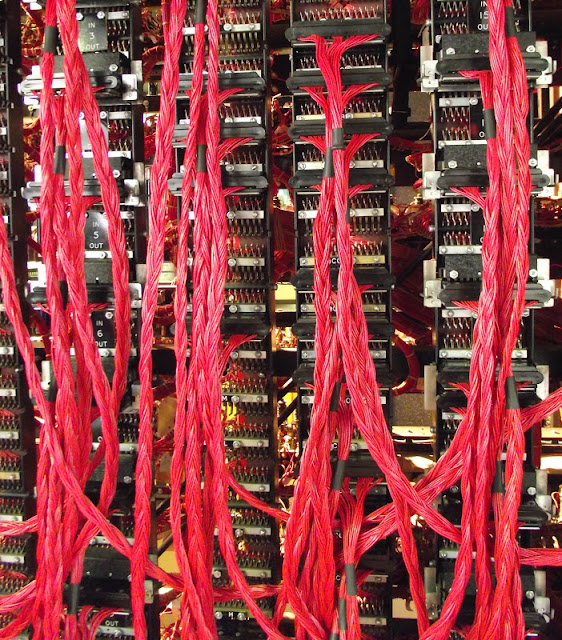


The Bombe, named after an earlier Polish machine used in de-encryption called the Bomba, itself reputedly named after an ice-cream, was built in just nine months and ready by March 1940. The machine made use of a 'crib', a known correspondence between a piece of cipher-text and the original plain-text, worked out from study of stereotyped messages, for example those commencing, "Weather report." In essence, the Bombe, each vertical set of three drums representing an Enigma machine (top), 'tested' the menus that were plugged up on the back of the machine (above) to reflect the crib.


A rotor order was chosen and an input letter selected. The Bombe worked through each possible rotor set-up, stopping each time a logical partner letter to the input letter was found. The resultant partial keys were tested on a Typex machine, modified to replicate an Enigma, to see whether the cipher-text would produce segments of German plain-text. Gradually, the rotor settings would be determined, such that ultimately all messages using that day's key could be decoded. Each day, the process had to start again.


At Bletchley Park, central to all this activity, is a fully working reconstruction of a Bombe. Entirely electro-mechanical, the machine is essentially a massive system of relays, emulating the rotor systems of 36 Enigmas. The design was continually improved, and by 1945 216 machines of various types were in use in the UK. Run 24 hours a day, without downtime for maintenance despite their 350 lubrication points (third photograph), the Bombes were incredibly robust. And proved absolutely vital to the war effort.

05 November 2012

Lewes Bonfire 2012

Bonfire has its origins in the celebrations that take place across the land to mark the ‘exposure’ of the Gunpowder Plot of 1605, although aspects of the event are likely grounded in Samhain, the Gaelic marking of the commencement of winter. It is now always held on 5 November, unless this is a Sunday, in which case it is advanced a day, but the roots of Bonfire lie in riotous events of no fixed point in the calendar.


These were suppressed by Oliver Cromwell, but reappeared upon the Restoration. The celebrations faded towards the end of the eighteenth century, yet grew once more in the 1820s. In 1847 the Riot Act was read to the bonfire boys, who were banished to Wallands Park, then outside the town. They returned to march through the town again in 1850, in response to a Papal Bull asserting the re-establishment of a Catholic hierarchy in England.


In order to preserve the ability to march in the town, the bonfire boys capitulated, and organised so as to control riotous behaviour. Lewes (now Borough) Bonfire Society and Cliffe Bonfire Society – Cliffe was then a separate borough – both formed in 1853. There are now seven Lewes bonfire societies, six of which process with flaming torches through the town on the same night.


Each society parades through its own quarter, and all bar Cliffe and South Street then march down the High Street. The five principal societies make, from wire and papier-mâché, a tableau reflecting topical dislikes, in most cases processed through the town before heading for destruction at the relevant bonfire and firework site. The societies return to their headquarters for bonfire prayers, broadsides against authority and current bogey-men.


Bonfire is a tradition, but a flexible one. Those parading wear either smuggler outfits – banded Guernseys, a different colour combination for each society, and white trousers – or ‘pioneer’ costumes, including Vikings and Moors for Cliffe, Zulus and Tudors for Borough. Since 1858 Bonfire has also commemorated the Lewes Martyrs, 17 Protestants burnt at the stake between 1555 and 1557. In more recent times its purpose has been extended to honour those killed in war, the processions halting at the town’s war memorial.

22 October 2012

Red House Glass Cone Museum


Once at the heart of the glass-making industry, surrounded by numerous cousins, the Grade II* listed glass cone in Wordsley, Stourbridge, is the only complete survivor in the area, and one of only four left in the United Kingdom. Brick-built, 90 feet high, and 60 feet across at its base, the cone was erected in 1790 by Richard Bradley and his brother-in-law George Ensell. 


The cone was used by Stuart Crystal until 1936. It was built originally, though, for the manufacture of window glass. This history is reflected in a pair of kiln-formed float glass curtains, by Robyn Smith and Robert Foxall Colley. The glass has been sand-blasted to form the pattern of lace curtains.

15 October 2012

The Floozie in the Jacuzzi


Victoria Square, Birmingham, has to one side the Council House, designed by Yeoville Thomason and completed in 1879 (above); and adjoining this the Town Hall of 1834 (below), actually a concert venue famous for its pipe organ, and designed by Joseph Hansom - he of the cabs - and Edward Welch.


When the square was pedestrianised in 1993 sculptor Dhruva Mistry won the international design competition for a central water feature. Weighing in at almost two tons, a fountain called The River dominates the upper pool. This is known locally as the Floozie in the Jacuzzi and, as currently, occasionally sports various articles of clothing.