Archaeology : Architecture : Art : Cold War : Curiosities : Design : Eccentricities : Ekco : Engineering : Industrial Heritage : Military : Petroliana : Photography : Shed Wonders : Transporter Bridges : Vintage Technology
22 January 2012
Beggar Thy Neighbour
The 1834 Poor Law Amendment Act stipulated that no able-bodied person was to be relieved by the Poor Law authorities except as the inmate of a workhouse, supposedly to reduce vagrancy; and that workhouse conditions were to be deliberately harsh, supposedly to discourage indigence.
Each parish, or union of small parishes, was to build a workhouse. That at Llanfyllin, for 250 paupers, was built in 1838, to a design by Thomas Penson, co-pupil with Thomas Telford of the famous bridge builder, Thomas Harrison. Grade II Listed, it is now in the hands of a local charity and provides the backdrop for an annual music festival.
Labels:
Architecture
14 January 2012
11 January 2012
Horsepower: Sufficient
The engine in the Phantom I, launched in 1925, this one nestling in its Cambridge garage, gives physical expression to the traditional response of Rolls-Royce to questions about horsepower: "Sufficient." With pushrod overhead valves, and two banks of three cylinders each, this giant straight-six 7.7 litre drives through a rubberised fabric coupling to the clutch, monumental four speed crash gearbox, and hefty torque tube.
Uphill in particular, it is quite capable of outpacing many a modern car, not least because one can, from the driver's seat, manually adjust the richness of the fuel mixture. A governor provides an early form of cruise-control. It apparently stops well, with servo-assisted brakes all round, and drives beautifully, semi-elliptic springs to the front and cantilever springs to the rear. This car, chassis 63AL, restored over the last 20 years, originally belonged to Sir Ernest Wills, the tobacco magnate.
Labels:
Engineering,
Shed Wonders
22 December 2011
Fab Prefabs
Herbert Austin built his car factory at Longbridge, Birmingham, in 1905. Initial production was 120 cars per year, but within a decade production had soared to 1,500 cars per year. The plant expanded accordingly, but when during WWI it was turned over to the manufacture of tanks and planes, it grew by a factor of ten.
To accommodate his workers close to the factory, in 1917 Austin bought land from Hawkesley Farm and, from Michigan, 500 prefabricated red cedar houses. One of the ships carrying the consignment was sunk on the crossing from the USA. The surviving prefabs, each 20' 6" wide and 35' 3" deep, were erected in a horseshoe pattern around a central spine, with brick semi-detached houses at intervals to act as firebreaks.
The whole estate, numbering 250 houses, was completed in just eleven months, and mature trees planted along the roads. The prefabs housed seven Austin workers each, and the brick semis twelve each. Originally licensed for just five years, now a conservation area, the estate is redolent of a different era.
Labels:
Architecture,
Curiosities
12 December 2011
The Biarritz of Wales
Aberystwyth is quite a remote town. Cambrian Railways reached it in the 1860s, when it underwent a typical Victorian boom. There's a fine promenade, with the Aberystwyth Electric Cliff Railway (the UK's longest funicular railway) up Constitution Hill at one end, and the harbour at the other.
Otherwise, though, and despite having once been promoted as the Welsh Biarritz, Aber is rather down at heel. It is not a town of impressive sweeps, but has a number of interesting corners and details. Every bench along the promenade boasts curling snakes, and those within the castle stylised sphinxes.
The Royal Pier was one of Eugenius Birch's, opened in 1865 at an original length of 794 feet. Just 299 feet still stand, rather a sorry sight. Many modern pier operators seem to have an unerring ability to ruin the little that remains. Nostalgia is not what it used to be.
Labels:
Architecture,
Photography
10 December 2011
RAF Tilstock
RAF Tilstock was operational between September 1942 and March 1946. As 81 Operational Training Unit, originally under 93 Group Bomber Command, it provided training on Whitleys and Wellingtons.
In January 1944 Tilstock transferred to 38 (Airborne Forces) Group, providing special operations training and, in preparation for the D-Day invasions, Horsa glider training, using Stirlings as tugs.
Many of the 1940s buildings remain, including a labyrinthine single storey complex of interconnected small rooms. Mostly windowless, this has the feeling of a bunker, albeit above ground.
There are remnants of a ventilation system and, in one room, a communications frame. Literacy has clearly been a problem for some time (second photo). Outside this complex lies what looks like a belt for a stationary engine.
A cluster of Nissen huts provides a feel for what it might have been like to be billeted here. In one stands, rather forlorn, a car waiting to have the depredations of the passing years polished out. It's understood to be a 1954 Sunbeam Talbot 90.
One runway is still used, for skydiving flights. The others were dug up and used as hardcore in the M54. The station's original control tower stands alone, boarded up. Just along the road from this, hard by abandoned Warren House, is what appears to be an air raid shelter.
Labels:
Military,
Shed Wonders
08 December 2011
Pistyll, Whipped

"What shall I liken it to? I scarcely know, unless it is to an immense skein of silk agitated and disturbed by tempestuous blasts, or to the long tail of a grey courser at furious speed. I never saw water falling so gracefully, so much like thin, beautiful threads as here" - George Borrow, Wild Wales, 1862.
Pistyll Rhaeadr, near Llanrhaeadr-ym-Mochnant, in the Berwyn Mountains, falls 240 feet in three stages. In full spate, and buffeted by high wind, the water is more powerful than graceful, flowing over the top of the natural arch that adorns the middle stage, and whipped into spray.
Labels:
Photography
26 November 2011
Brobdingnagian Brogyntyn
There has been a house on the site of Brogyntyn Hall, just outside Oswestry, for a millenium. The gorgeous present building was erected in 1739. The fine Ionic-columned portico was added in 1815 by William Gore, the Irish landowner.
Gore's eldest son, John Ralph Ormsby-Gore, was created Baron Harlech in 1876, and Brogyntyn Hall remained in the Harlech family's hands for the next century. The scourge of death duties ultimately did for the hall, which has stood empty since 1985.
Although sold to developers in 2005, Brogyntyn remains uninhabited. With a grand stable block, an intact ha-ha, a huge walled produce garden, and extensive parkland, this is a country house that cries out to be saved, not carved-up.
Labels:
Architecture
19 November 2011
Happy Birthday Jensen & JOC
2011 is a key year for the Jensen marque. Jensen Motors Ltd was formally founded 75 years ago. And the Jensen Owners' Club was inaugurated 40 years ago, in December 1971. In celebration of the latter the JOC has issued an anniversary grille badge, in a limited edition of 100. Badge number 100 was won in a competition, and has been proudly fitted to The Beast.
Labels:
Engineering,
Petroliana
16 November 2011
Pershore, Worcestershire
The date of the monastic foundation here is obscure. The abbey was refounded during the reign of Edgar (959-975), but destroyed by fire circa 1002. There is evidence of it again being operational by the 1020s, but much of that which remains dates to about 1100. The abbey was dissolved in 1539, the church retained to serve the parish. The north transept collapsed in 1686. Significant restoration was undertaken in 1852 by George Gilbert Scott; and the massive western buttresses were added in 1913.
Labels:
Architecture
13 November 2011
Crusaders, in Religion & Engineering
The landscape immediately north of Langley Chapel (see next) is dotted with interesting features. Not only is there Acton Burnell Castle - YMGW passim - but also half-timbered Pitchford Hall, in the grounds of which is a 17th-century tree house. Adjoining the hall is St Michael and All Angels, wherein is this remarkable effigy of Sir John de Pitchford (d. 1285), carved from a single block of oak.
A little further north still is Cantlop Bridge. Built in 1813, this is the only one of the seven cast-iron Shropshire bridges approved by Thomas Telford still in situ. With a flat deck, it is a smaller version of Cound Bridge, now in use as a footbridge in Telford town centre.
Labels:
Art,
Engineering,
Industrial Heritage
Puritan Shropshire
Langley Chapel is Tudor in origin. When nearby Langley Hall disappeared and the local population declined the chapel was slowly abandoned, relatively early in its life. Because of this, and its remoteness, it remains much as it would have been in Puritan times.
The furnishings, of the early 17th century, consist of pulpit (on the left, above), reading desk with seating within (on the right), box pews, and benches. In Puritan tradition, there is no altar, but instead a communion table, about which are ranged kneeling desks to three sides.
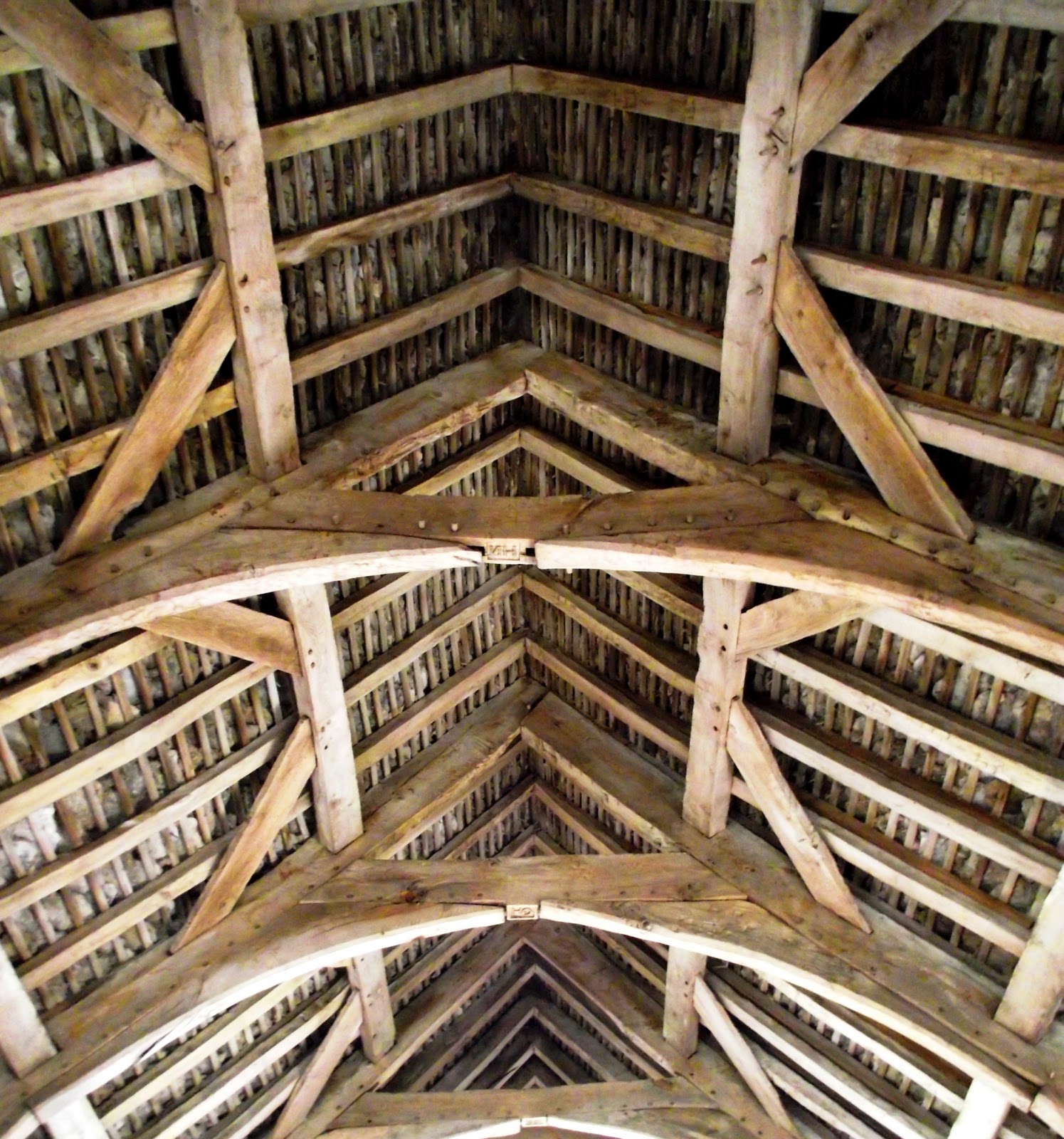
The nave and chancel are not structurally separate, but marked by different roof constructions, collar-braced in the former and trussed rafter in the latter.
Labels:
Architecture
09 November 2011
Moreton Corbet Castle, Shropshire
There has been a castle here since the early 12th century, passing to the Corbet family, to whom it still belongs, circa 1239. The timber buildings were replaced in stages from about 1200, the oldest surviving building, the Great Tower, dating from that period.
In 1580 Sir Robert Corbet constructed a massive residential range in Italianate style (first three photographs). The house was severely damaged during the English Civil War, Sir Vincent Corbet having fought with the cavaliers. Although repaired, the castle was abandoned as a residence in the 18th century.
Hard by is the parish church of St Bartholomew, home to a number of Corbet family monuments, including a fine chest tomb of Sir Richard Corbet (d.1566) and his wife Margaret.
Labels:
Architecture
27 October 2011
Clever, Those Chinese, Very Clever
When the engineering solution to a problem is simple we tend to overlook the elegance of its simplicity. Chamber locks, with gates at both ends, were in use in China by the tenth century. They were likely introduced to Britain from the Netherlands, where the first recorded example in Europe was at Vreeswijk, from 1373. This example, on the Montgomery Canal, is one of a sequential pair.
Labels:
Engineering,
Industrial Heritage
15 October 2011
Welsh Mustard
The Valley Works of Rhydymwyn, near Mold, was founded in 1939 as a facility for the production and storage of mustard gas by ICI’s Special Products Division. It takes its name from the Alyn Valley. The Alyn was culverted and, back in the days before we pretended to give a damn about the environment, used to discharge toxic waste into the estuary of the River Dee.
Mustard gas production stopped at the end of WWII. From 1947 to 1959 the tunnels were home to the UK's strategic stocks. Ultimately the material was dumped at sea or burned on site, which remained as a buffer depot until the early 1990s. Some remediation work was undertaken in 2003, but the site undoubtedly remains toxic, and is thus securely fenced and guarded.
There were originally 200 or so buildings. About 50 remain. One, building P6, was converted in 1942 to house equipment used to test how feasible it might be to separate the isotope U-235 on an industrial scale. This was for Tube Alloys, the codename for part of Britain's nuclear programme. This ended in 1945 when America constructed and used the world's first nuclear weapon, humankind's next generation of WMD.
10 October 2011
Llanymynech Toposcope
High above the village of Llanymynech, on the border of England and Wales, is the Border Viewpoint, a toposcope fabricated in 2011 by Tanya and Gideon Petersen. The toposcope proper is rather crudely made, but the supporting frieze, in hot-forged steel, has as its right-hand panel a very effective silhouette of the interior of the Hoffman kiln that can be seen in the plain below.
Labels:
Art,
Industrial Heritage
07 October 2011
Triumph Dolomite 1500 SE
At 32 years' old and given Leyland's reputation for patchy build quality using dodgy steel, that the Dolomite passed its MOT is pleasing. FGU 417V was likely saved by its immediate post-build application of Cadulac rust-proofing. With new rear tyres, replaced indicator flasher unit, and adjustment of the handbrake cable, she's good to go.
The DVLA cites just 36 remaining examples. Of those, only a dozen are understood to be running around. If you have a 1500 SE, please drop YMGW an email with your name, location, car registration, and some information about whether it's on the road.
Introduced in 1979, just 2,163 SEs were produced. You could have it in any colour and options scheme you desired, as long as your choice was black paint, full-length silver stripe, front spoiler, and Spitfire-type wheels. They all have burr walnut door caps and dashboard, grey velour seats, and grey carpet.
The DVLA cites just 36 remaining examples. Of those, only a dozen are understood to be running around. If you have a 1500 SE, please drop YMGW an email with your name, location, car registration, and some information about whether it's on the road.
Labels:
Engineering,
Shed Wonders
04 October 2011
Bencroft Wood
One of the four woods that go to make up the larger reserve of Broxbourne Woods - YMGW passim - Bencroft Wood, Hertfordshire, is predominantly of hornbeam coppiced for many hundreds of years. This supplied the maltings of Hertford and Ware with fuel, and charcoal for the manufacture of gunpowder. The above truck find is likely beyond identification.
Labels:
Photography,
Trees
01 October 2011
Yet Another Fine Car, Stanley!
To have one steam car turn up at a local café - YMGW passim - is more than a little unusual. To have another do the same just a few weeks later is quite incredible. This is another 1909 Stanley, a 10hp Model E2, same owners. The hand-painted coachwork is stunning.
Labels:
Curiosities,
Eccentricities,
Engineering