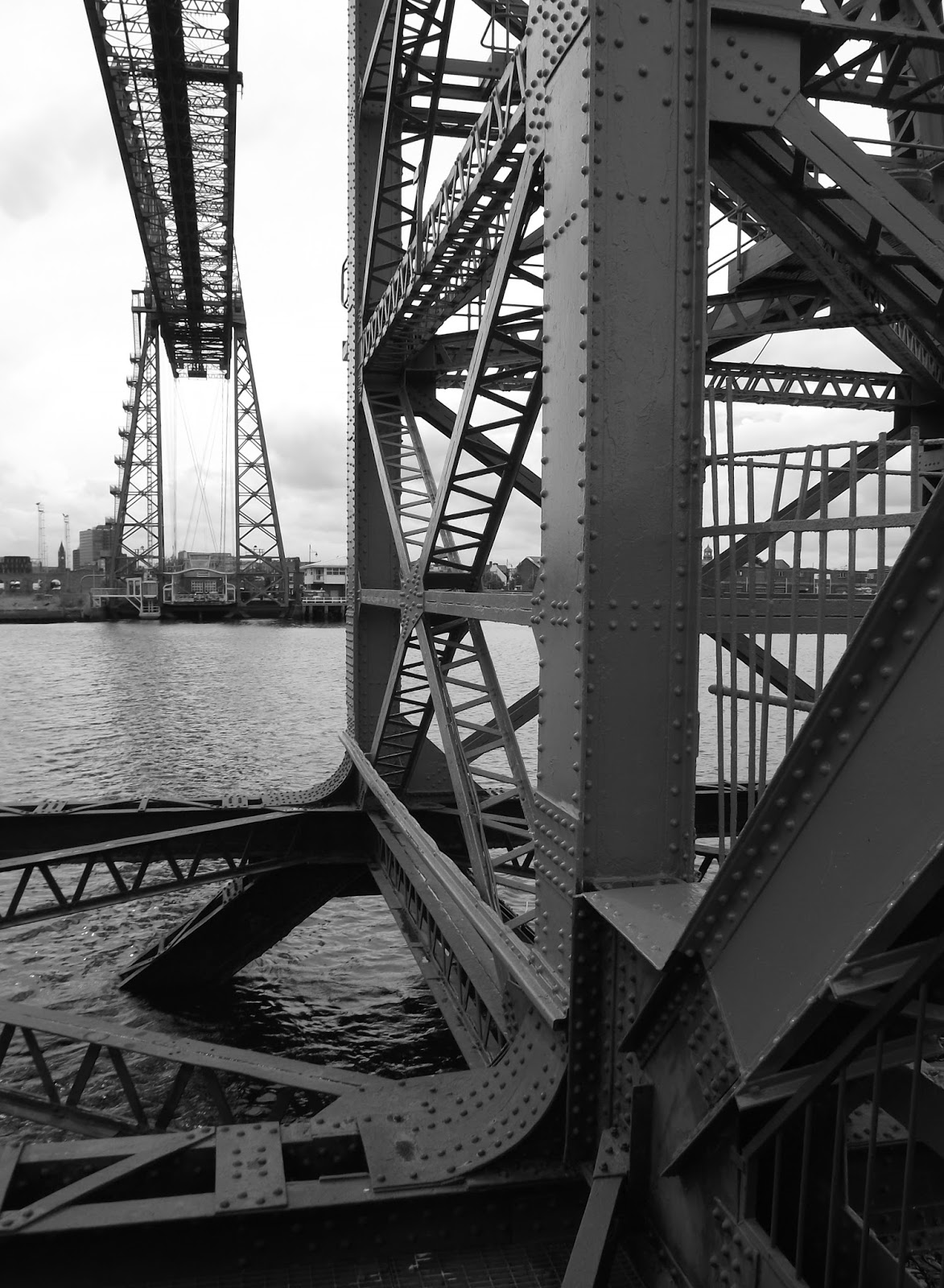
Designed by William Henry Hunter and built by Sir William Arrol & Co., the bridge has an overall length of 339 feet, a span of 200 feet, is 30 feet wide, and has a height above the high water level of 79 feet. The cantilevered truss structure is founded in massive concrete caissons, faced in engineering brick. These, and the heavy double cantilevers to each of the four towers, shout the industrial use.

The bridge is alternatively known as Crosfield's No.2, as there was another 'bridge' on the site, slightly further north. Built 1905-07, and in service from 1908, Crosfield's No.1 is oft-cited as a transporter bridge, yet there is no evidence that it ever carried a gondola, which disqualifies it from the club. It was, in effect, a gantry crane. The trolley of No.1 was removed by the time of WWII, and the structure was demolished in the 1960s.

Warrington (Bank Quay, Crosfield's No.2) Transporter Bridge is a unique survivor worldwide, in that the gondola was constructed to carry railway stock. The only other example that did so was the Kiel transporter bridge, demolished in 1923. The rails continued right up to the edge of the aprons either end of the bridge (above) and onto the gondola, and can still be seen in the adjoining east bank chemical works yard. The gondola was converted for dual rail and road vehicle use in about 1940, and strengthened circa 1949 to increase the carrying capacity from 18 tons to 30 tons.

The bridge ceased operations in about 1964, and now stands in a very dilapidated state, the gondola stranded on the inaccessible west bank. Despite being scheduled as an ancient monument, Grade II*-listed, and included on the Heritage at Risk Register, the bridge has been left to rot, a victim of its Warrington Borough Council ownership.