19 February 2014

Cyprus Car Graveyard


In eastern Cyprus, on the road north from Dhekelia, towards Achna, is a house-cum-workshop surrounded by dozens of British, French, Italian, German, Swedish, Japanese and American cars of the 1960s onwards, awaiting restoration.


Many are in remarkable condition, and could be easily recommissioned, including a lovely Mercedes 220 (top). There are at least half a dozen Audis: 80s, 100s, an 80 Fastback (above), a 5S, a couple of proper early Quattros, and a muscular Coupé (below).


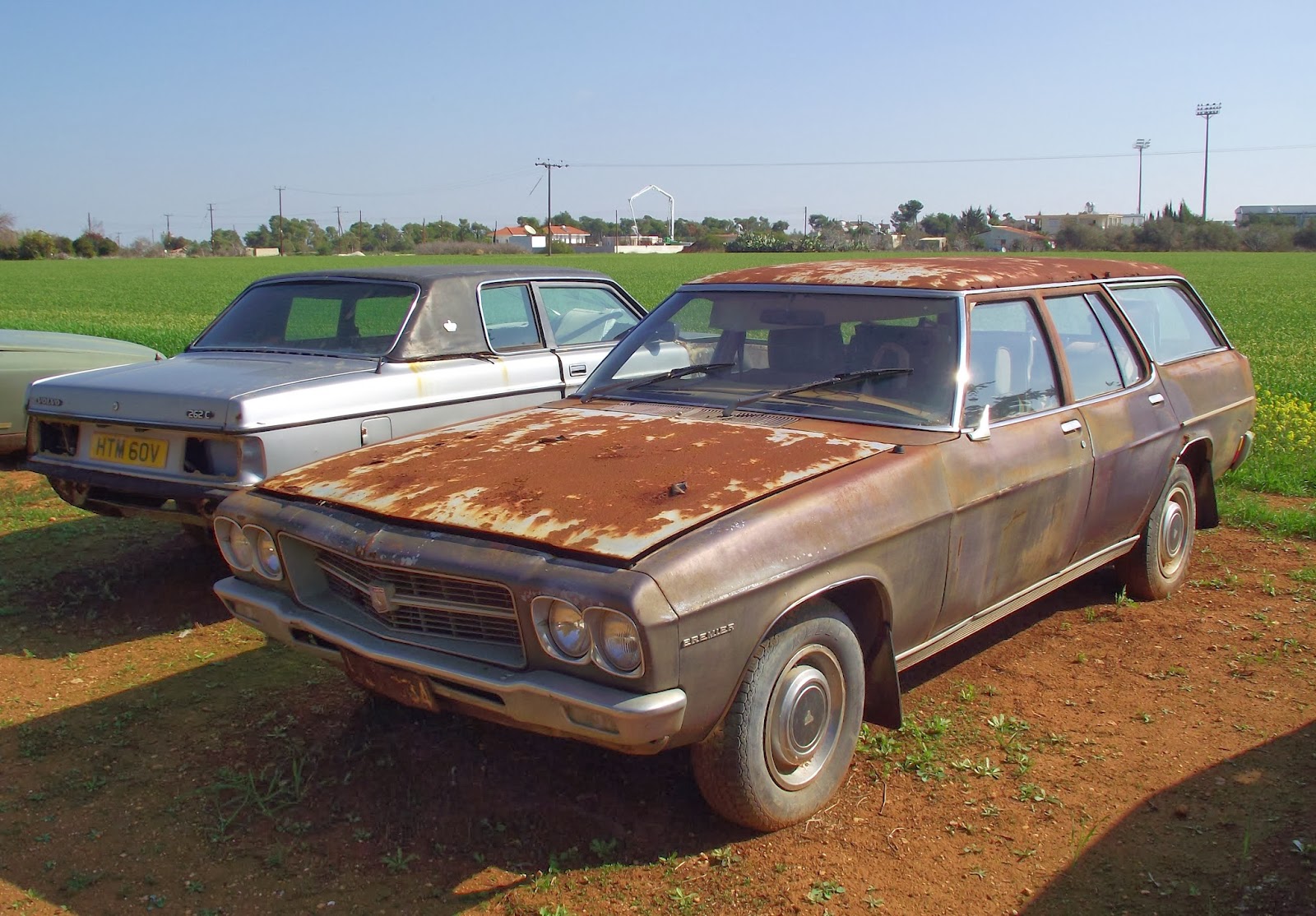
The Brits are represented by a Triumph 2000 and a number of Jaguars, including two XJS V12s; one set of the colonial cousins by a Chevrolet Beretta, a Lincoln and a 1969 Chevrolet Camaro (below, identified by Rupert Lloyd Thomas); and another set by a couple of Holdens, one a Premier 202 (next below).


The dry conditions have been kind to very many of the cars, which whilst most have suffered some form of accident damage, it would be nice to think might again see the open road. There are quite a few Volvos, including a beautiful P1800 ES, in that icy blue that so suits them.


It is to those Italian cars that are so prone to rot to which the weather has been most kind. Fiat is represented by a 130, a 131S and a 132. There's a bevy of Alfa Romeos, including an early Spider and a pair of Alfettas, the paintwork of one well protected by foliage (below).


One might expect the Saabs to have survived without difficulty - these include a 95 (below) and a 99. Even a Datsun ST is still in one main piece.


It is though on behalf of the French machinery that one is most grateful to the weather. The collection includes a Citroën CX, a Peugeot 604 V6, and no fewer than two instances of the stunning Citroën DS Pallas (below).


16 February 2014

First Bakelite Ekco

Ekco's first Bakelite-cased radios were the 312 and the 313, both released in 1930. At this time Ekco, the first wireless manufacturer to make Bakelite cabinets, had these moulded for it by Allgemeine Elektricitätz-Gesellschaft (AEG). The company installed its own presses, under AEG supervision, at its Southend-on-Sea factory in 1931, upon the imposition of high import taxes. The exquisitely-detailed cabinet of the 313, which was available from July 1930 in mahogany (this example), special order medium oak, and special order dark jade, was designed by L. Smithers. 


The set had a drum-drive scale, was available in AC (pictured) and DC versions, and cost £22.10s.0d. One then had to buy a loud-speaker. There were two options, the pictured moving-iron cone LS1 Ekcone, at £5, or the moving-coil LS2 Ekcoil, at £11. The wireless and cheapest speaker would have cost over ten weeks' of the average wage of the time, putting it out of reach of all but the most affluent. 84 years on, this 313 is in remarkable, and full working, condition.

14 February 2014

Hobbit Mill


Birmingham was once home to innumerable watermills. Grade II-listed Sarehole Mill, on the River Cole in Hall Green, is one of only two left. The mill was founded in 1542, and has gone by various names, including Bedell's Mill and High Wheel Mill. Its true fame lies in it having been leased by the industrialist Matthew Boulton, who used it for rolling iron and drawing wire.


The current building, of 1771, post-dates Boulton's use of the site, and was operated until 1919. The period after WWI saw the ending of very many ways of life that had previously seemed resistant to major change. JRR Tolkein lived immediately nearby as a child, and the mill is cited as inspiration for that in The Lord of the Rings' Hobbiton. Tolkein would be appalled by all the litter in and along the Cole.

30 January 2014

Jellied Eels


Pie 'n' mash shops were once common across East and South London, but are now few and far between: tastes and quality expectations have moved on. Few would frequent Cockneys, in Frith Road, Croydon, for the standard of the fayre. The menu consists of 'beef' pie, stewed or jellied eels, mashed potato, liquor (once made using the water in which had been cooked the eels, but now parsley sauce), and tea.


Yet the plain decor of clean white wall tiles, half a dozen booths of wooden benches and marble-topped tables, and black-framed monochrome photographs of pearly kings and queens, is very inviting. Vinegar, the traditional condiment for pie 'n' mash, is supplied in the form of large reused Jack Daniel's bottles.

28 January 2014

Shrewsbury Battlefield, 1403


On 21 July 1403, the armies of King Henry IV and Henry Percy engaged each other about three miles north of the centre of Shrewsbury. The Battle of Shrewsbury was an exceedingly bloody one, the first occasion on which English longbow archers had fought each other, and resulted in an estimated 5,000 deaths.


The Percy family had backed Henry in his war with Richard II and had helped him to the throne in 1399. Henry, however, reneged on his promise of reward lands, and failed to provide funds to help the Percys protect the north of the kingdom. The Earl of Northumberland, with others, set out a list of grievances and demands, and his son, Henry Percy, known as Hotspur, headed south. In Cheshire he recruited experienced archers, but his army likely consisted of no more than 14,000. Hotspur's expected reinforcements, under Owain Glyndŵr, never arrived.


Henry IV was already on his way north, ironically to assist the Percys against the Scots. The king was apprised at Burton-on-Trent of the revolt of the Percys, and headed west to address the new threat, with a force estimated at anything up to 60,000. Battle was joined about a mile south of where now stands Battlefield Church.

The Cheshire bowmen inflicted much damage, and Henry's right wing broke down. Hotspur led a charge directly upon the king in an effort to capitalise upon a temporary advantage against superior force. The battle ended when it became known that he had been killed in the attempt: "...time, that takes survey of all the world, / Must have a stop" (Henry IV, Part 1, Act V, Sc. 4).


A chantry chapel, reputed to lie above a mass grave associated with the battle, was completed in 1409. A year later this became a college of chaplains. There are remains of the fishponds that sustained the chaplains. The chapel was integrated into a larger church, completed about 1460, which itself became a parish church in 1548. Heavily restored in 1860-62, the church was declared redundant in 1982.

03 January 2014

Gerry Wells - Valveman


The British Vintage Wireless and Television Museum, Dulwich, is housed in the home in which its creator, Gerry Wells, was born in 1929. Gerry has spent his life in the world of radio and television, building them from scratch (including his WADAR brand), repairing them, stealing them, and collecting them.


His interest in everything electrical started at age four, and truly amounts to the Obsession that is the title of his fascinating autobiography. The museum commenced in 1974, when it was focused on wireless - it has subsequently expanded into 405-line television.


Many of the vintage TVs on show are in full working order, fed via standards converters. These include that used by the BBC to convert from 625 to a transmittable 405 lines, when they were running dual standards - being the size of a double wardrobe, this is appropriately housed in Gerry's bedroom.


This and the kitchen are the only rooms of a normal domestic character. The rest of the house is full to the gunwales with vintage wireless and TV sets. There's a room of 1920s equipment (top), one largely of Ekcos (second photo), another of early transistor portables (third photo), and yet another partly fitted out as a period wireless repair shop (above).


It doesn't end there though. At the end of the garden is a series of interlinked sheds, one with a clerestory roof, all built by Gerry. These are also full of sets, grouped by manufacturer, and of display cabinets of various components; and house Gerry's workshop. In all, a staggering 1,300 sets are on display.


25 December 2013

The Sweeney


Sweeney Mountain in Shropshire is, at only 620 feet above sea level, not a mountain.  However, a number of buildings taken back by nature are testament to the fact that when the weather's against one it can be cruel up here.


"Sweeney" may be a corruption of "swaney." The country house that is now the Sweeney Hall Hotel was, in an earlier incarnation, the property of one Thomas Baker, in 1649 granted a crest of arms featuring four swans' heads.


13 December 2013

Aberystwyth Harbour


Although Aberystwyth means Mouth of the Ystwyth, the river that actually runs through the town is the Rheidol. The Ystwyth, beside which there are a number of knocked-together sheds, flows under the bridge to the harbour pier and into Aberystwyth harbour, south-west of the town.


The harbour was for most of its life impeded by a large sandbar that extended into the estuary, and only small sloops and smacks, mostly herring boats, were able to operate. It was radically improved in the late 1830s, through construction of a stone quay and an adjoining stone pier (below).


The new harbour enabled larger boats to make port. Boat-building, largely of schooners, also developed in a small way, although within 30 years the expanding railways had significantly affected the trade. The last ship was built in 1881.


21 November 2013

Canvey Island Concrete

Just five miles east to west, three miles north to south, and of seven square miles, Canvey Island, in the Thames estuary, feels like a world of its own. The low-lying land is criss-crossed by creeks, and accessed by means of one of two bridges.


Settled since the Roman period, Canvey was first protected from the sea in the 1620s, the reclamation work, which conjoined a number of smaller islands, possibly undertaken by the Dutch engineer Cornelius Vermuyden. The island was largely agricultural until the twentieth century, but in the 1930s became popular with Londoners wanting to take the air.


The International style Labworth Café, of reinforced concrete, was opened in 1933. This is the only building in the world designed solely by the famous engineer Ove Arup, who modelled it upon the bridge of RMS Queen Mary. Originally called the Canvey Island Café, this became known by the word "Labworth" painted in large letters on the inland side, the building constructed as it was on the Labworth Estate.


Canvey was inundated in 1953 by the North Sea flood, which claimed 58 lives, and between 1973 and 1982 gained 15 miles of upgraded and massive sea walls, running around 75% of the island. Construction of these buried the supporting piles of the Labworth, reducing it to two storeys.


The building only narrowly escaped demolition, but found a new lease of life in the late 1990s, having been Grade II listed in 1996. In 2001 the building was altered again, decidedly for the worse, when the shelters that had formed its wings, which originally had ship-like railings atop them, were enclosed.


During WWII a common weapon against shipping was the magnetic naval mine, often dropped by parachute. Although this was largely a redundant technology by the time of the Cold War, in 1963 the Admiralty built the Degaussing Range Station (below), known locally as the Canvey Loop.


In two loops of thick cable on the bed of the Thames a charge was induced by the magnetism of passing ships' hulls, which charge was detected at the station. Where the readings demanded this, the ships could then be degaussed. The station closed when the new seawall, the steel piles of which would have severed the cables, was constructed, although it was only declassified in 1993 - the equipment remains partially secret.


19 November 2013

Springfield Brewery, Wolverhampton


In about 1840, William Butler, a grocer by trade, started selling home-brewed beer to his fellow workers at Wolverhampton's Shrubbery Iron Works, where he was a shingler. Two years later, Butler left his job and became a full-time grocer and brewer. By 1848 he had built the Priestfield Brewery in the city.


The wells here began to run dry as demand increased, so Butler moved production to Springfield, which had a good water supply and was hard by both the canal and the railway, making for convenient transport of his beers. The Springfield Brewery was fully operational by 1874, and included maltings, a cooperage and stables.


The Great Western Railway ran a siding into the site, which expanded as did business. A new brewing tower was brought on stream in 1883. William died in 1893, when his son, also William Butler, pursued an aggressive strategy of acquiring rival breweries so as to increase Butler's number of tied houses. Both Bloxwich Brewery and Cannock Brewery were acquired in 1925, and Eley's in 1928.


This expansion continued into the 1950s, making Butler's one of the Midlands' largest brewers. It was itself incorporated into Mitchell's and Butler's in 1960, which in turn was taken over by Bass just a year later. Brewing ceased at the site in 1991, and the buildings were gutted by fire in 2004.

17 November 2013

Ekco & Animation


The Ekco AC86 was released in 1935, a year after the AC85 of which it was a restyle, the cabinet design undertaken by Serge Chermayeff. The set was available in both walnut (pictured) and black Bakelite, the latter with chromium detailing. A wooden stand was available for £0.29s.6d.

The AC86 could also be had in AC/DC (AD86), battery (B86) and export (SW86) versions. It is known to vintage radio enthusiasts as the 'Dougal'. When first bought, the set would have swallowed 13 guineas, about £820 in today's money, and three to four weeks' of the average wage of 1935. Quite how much LSD was ingested by the radio's namesake from The Magic Roundabout is not known.

The AW70 was released in 1939. It operated only on alternating current, but was available also in battery form (BAW71). By this point, immediately pre-war, Ekco was no longer producing black and chromium variants, although it did so again in 1945 with the A22.


The set's dial features the word "Aircraft" at 900 metres. A feature first introduced in 1934, this marked the frequency at which one could listen to traffic between airborne 'planes and the control tower at London Airport, Croydon, unthinkable in today's controlled world. It was presumably the AW70 that inspired the design of the alarm clock merchandise spin-off from Aardman Animations' 2000 film Chicken Run, being spirited away by Fetcher and Nick

09 November 2013

Broadwell Conduit Head, Shrewsbury


Hidden away in the woods of the Nobold area of Shrewsbury, Shropshire, are the remains of the sixteenth-century conduit head from which the town was supplied with water from 1556, right through to 1947.


The conduit head building, Grade II listed, is constructed of roughly-squared red sandstone, timber trusses to each gable, and plain tiles, and dates to about 1578. Inside is a single space, taken up with a brick-lined water tank.


Water was collected from nine wells in the immediate vicinity, seven of which can be easily located amongst the briars. The wells are accessed by a series of interconnected and covered boardwalks, tiled with shingles.


From the site, known as Broadwell, water was piped into town, originally in hollowed-out elm trunks, elm being resistant to decay when permanently wet. Five of the later outlets once associated with the system survive in the town.


Originally a licensed private enterprise, the facility was acquired by the town's corporation in 1878. On the same site is a later pumping house, of 1903, which was in the 1980s converted by Severn Trent Water into a visitor centre, now closed and vandalised. The council acquired the site in 2007, but has, of course, done nothing with it.


08 November 2013

Ekco & Sir Misha Black


Amongst the architect-designers engaged by Eric Kirkham Cole to design Ekco's Bakelite radio cabinets was (later Sir) Misha Black. Azerbaijan-born, Black came to England aged two. His design for Ekco's AC/DC UAW78 of 1937, pictured, evinces shades of Ellis, Clarke and Williams's 1932 Daily Express Building in Fleet Street, London, with its round corners in vitrolite and clear glass, an icon of Art Deco architecture. Original price £11.0s.6d. A battery version (BAW78) and an accumulator/vibrator version (BV78) were also available.

In 1943 Black founded, with Milner Gray, Design Research Unit, one of the first practices to address itself to architecture, industrial design, and graphics. DRU had significant involvement with the 1951 Festival of Britain. Black developed the external styling of British Rail's Class 71 electric (1958), and Class 52 diesel (1961) locomotives; and designed Westminster's street name signs (1968) and the iconic geometric orange, black, yellow and brown moquette used on London Transport seating (late 1978).