One of the normally inaccessible features of the Rhydymwyn Valley Works, developed by ICI in 1939 to manufacture and store mustard gas, is the tunnel system. Three tunnels (central one in bottom photo) were driven about 600 feet into the side of the valley, through limestone, and connected by four cross-tunnels, the stores (below). The system was designed to enable the storage of 3,120 tons of mustard gas, both Runcol and Pyro.
The site's production facilities were closed at the end of the war, when most of the UK's chemical weapons stocks were simply dumped at sea. But the country's then 'strategic reserve' of mustard gas remained stored in the Rhydymwyn tunnel facility until its destruction in 1958-60.
The store was ventilated by means of two huge extractor fans, at the top of the chimneys at the ends of each of the north and south tunnels. Air was drawn into the tunnels, deflected into a void above a mild steel ceiling throughout the storage areas, down through vents in this, and drawn out through grille-covered floor ducts, and up the chimneys. The steel ceiling was carried on concrete corbels.
Archaeology : Architecture : Art : Cold War : Curiosities : Design : Eccentricities : Ekco : Engineering : Industrial Heritage : Military : Petroliana : Photography : Shed Wonders : Transporter Bridges : Vintage Technology
27 June 2016
19 June 2016
Borderlands Rare Vintage Tin
The Clwyd Veteran and Vintage Machinery Show, held annually, throws up some real rarities amongst its shows of cars, commercial vehicles, bicycles and motorbikes, steam and stationary engines, tractors and horticultural machinery. The Lotus Europa (above) was a mid-engined GT, built in Hethel, Norfolk, between 1966 and 1975.
Karrier, part of Clayton and Co. of Huddersfield, started making small commercial vehicles in about 1907, and later moved into manufacturing buses and trolley-buses. It was bought by Commer, part of the Rootes Group, in 1934, itself acquired by Chrysler in 1967, who dropped the brand. This Karrier Bantam was a coal lorry.
NSU, an abbreviation of the company's home town of Neckarsulm, was founded in 1873. It was acquired by Volkswagen in 1969, and merged with Auto Union, who owned the Audi brand - the company name changed to Audi in 1985. The last NSU-badged car was the Ro80, with a twin-rotor Wankel engine and a semi-automatic vacuum transmission, built from 1967 to 1977.
Clan was formed in Washington, Co. Durham, in 1971, by a team of ex-Lotus engineers; and closed in 1973. It re-emerged as Clan Cars in the early 1980s, based in Newtownards, Northern Ireland. In 1985 it released the Clan Clover, with an Alfa Romeo powertrain. The company failed anew in 1987, having built only 26 Clovers.
Labels:
Curiosities,
Design,
Engineering,
Petroliana
31 May 2016
Blackpool Tower - Highs and Lows
Blackpool Tower is Lancashire's answer to, and was inspired by, the Eiffel Tower. It was designed by Lancashire architects James Maxwell and Charles Tuke. Heenan and Froude of Worcester, structural engineers, both supplied and built the tower proper. Architects draw, engineers build.
Unlike its Parisian cousin, Blackpool Tower is not free-standing. Its base is surrounded by a monumental building that occupies 54,400 square feet, constructed from more than five million Accrington bricks. The tower proper is formed of 2,493 tons of steel and 93 tons of cast iron, hydraulically riveted together.
The foundation stone was laid in September 1891, and the tower opened in May 1894. 518 feet tall, the tower was inadequately painted during its early years. As a consequence between 1921 and 1924 all the steel-work had to be replaced.
The tower closed during WWII, and the crow's-nest was removed in 1940 to allow for the installation of a radar array, the station known as RAF Tower. Normal service resumed in 1946. The two hydraulic lifts were replaced in 1956-57 by electrically-driven ones. They were replaced again in 1991, and carry one up 315 feet.
A walk-on glass floor to the sea-facing side of the enclosed observation deck, over 380 feet up, was installed in 1998. Two open decks above this are accessible by means of stairways. Not accessible to the public are the 563 steps from the top of the brick building to the tower top, used by the maintenance teams, which coat the tower in nine tons of paint each time it's repainted.
Sadly, it is impossible to simply ascend the tower to appreciate the engineering. The only way up is to purchase an extortionately-priced 'experience', involving endless schmaltz and a pointless '4D' cinema show. These can both be bypassed if one insists, but the queues, disorganisation, bored staff pushing gift shop tat, and rip-off entry fee cannot. The tower is Grade I listed, and deserves much better.
Labels:
Architecture,
Curiosities,
Engineering
15 May 2016
Rochefort Transporter Bridge
Frenchman Ferdinand Arnodin, with Spaniard Alberto de Palacio, was the patentee holder for the first transporter bridge design brought to realisation, just outside of Bilbao, Spain. Five transporter bridges were built in France, more than in any other country: at Brest (relocated from Bizerta, Tunisia), Marseille, Nantes, Rochefort, and Rouen; with a sixth commenced at Bordeaux but never completed. All were designed by Arnodin. Only the Rochefort bridge remains to France.
Crossing the Charente River, construction of the 700 ton iron and steel Rochefort Transporter Bridge commenced in March 1898 and was completed in July 1900. The towers, marked with Arnodin's name on each of the 16 shoes, stand 217 feet high, and the bridge has an overall length of 575 feet, with a main span of 459 feet at beam level. The beam is 26 feet wide and 154 feet above high water level. The suspension cables terminate in massive anchorages (below). The uppermost cables run back to additional anchorages built in 1933 when the bridge was converted from being predominantly cable-stayed to being entirely of the suspension form.
The bridge was abandoned in February 1967 upon opening of a nearby vertical lift bridge, itself demolished in 1991 after opening of the Martrou viaduct road bridge (in background of first photo). Funds were put aside in 1975 for the bridge's demolition, but it was declared an historic monument in April 1976, and refurbished between 1990 and 1994.
The bridge is normally open in the summer months for use by pedestrians and cyclists. At the time of writing it has been closed for a predicted three year period, to replace the boom with one constructed much more closely in accord with Arnodin's original design, and to revert to the original largely cable-stayed format, at an estimated cost of £27 million. There is a good museum on the Échillais (Martrou) side of the river.
10 April 2016
April Fools' Car Show 2016
The show winner was John Watson's immaculate 1910 Buick, complete with Selden patent licence plate. (Selden had never built a single example, but in 1895 was granted a US Patent for the automobile, much to the ire of Henry Ford.) Runner-up was Syd Brode's gorgeous 1950 3.5 litre Jaguar Mk V.
Labels:
Design,
Engineering,
Petroliana,
Vintage Technology
31 March 2016
Bilbao - Guggenheim Museum
The interior boasts about 120,000 square feet of exhibition space, in 19 galleries ranged around an impressive central atrium. Ten of these are orthogonal in shape, with an external finish of stone. Nine are of irregular form, with an external cladding of titanium panels.
Labels:
Architecture,
Art,
Craftsmanship,
Design,
Engineering
30 March 2016
Bilbao - Ascensor de Begoña
In the heart of Bilbao's Casco Viejo, the Old Town, is a monumental and incongruous concrete structure that looks like it might be more at home overlooking a Soviet gulag.
It is in fact the Ascensor de Begoña, a set of elevators that takes one up to Park Etxebarri and the 16th-century basilica. The fare is €0.45 per trip, paid to the unfortunate elevator jockey who spends all day stuck in a lift.
Labels:
Architecture,
Curiosities,
Engineering
28 March 2016
Bilbao - Transporter Bridge
Puente Vizcaya, just outside Bilbao, and connecting Portugalete and Las Arenas, is the oldest transporter bridge in the world, the first of just 19 built to completion worldwide, and the only one built in Spain.
The bridge was designed by Spaniard Alberto de Palacio and engineered by Frenchman Ferdinand Arnodin. Construction commenced on 10 April 1890, and the bridge officially opened on 28 July 1893. The influence of the Eiffel Tower of 1889 is obvious.
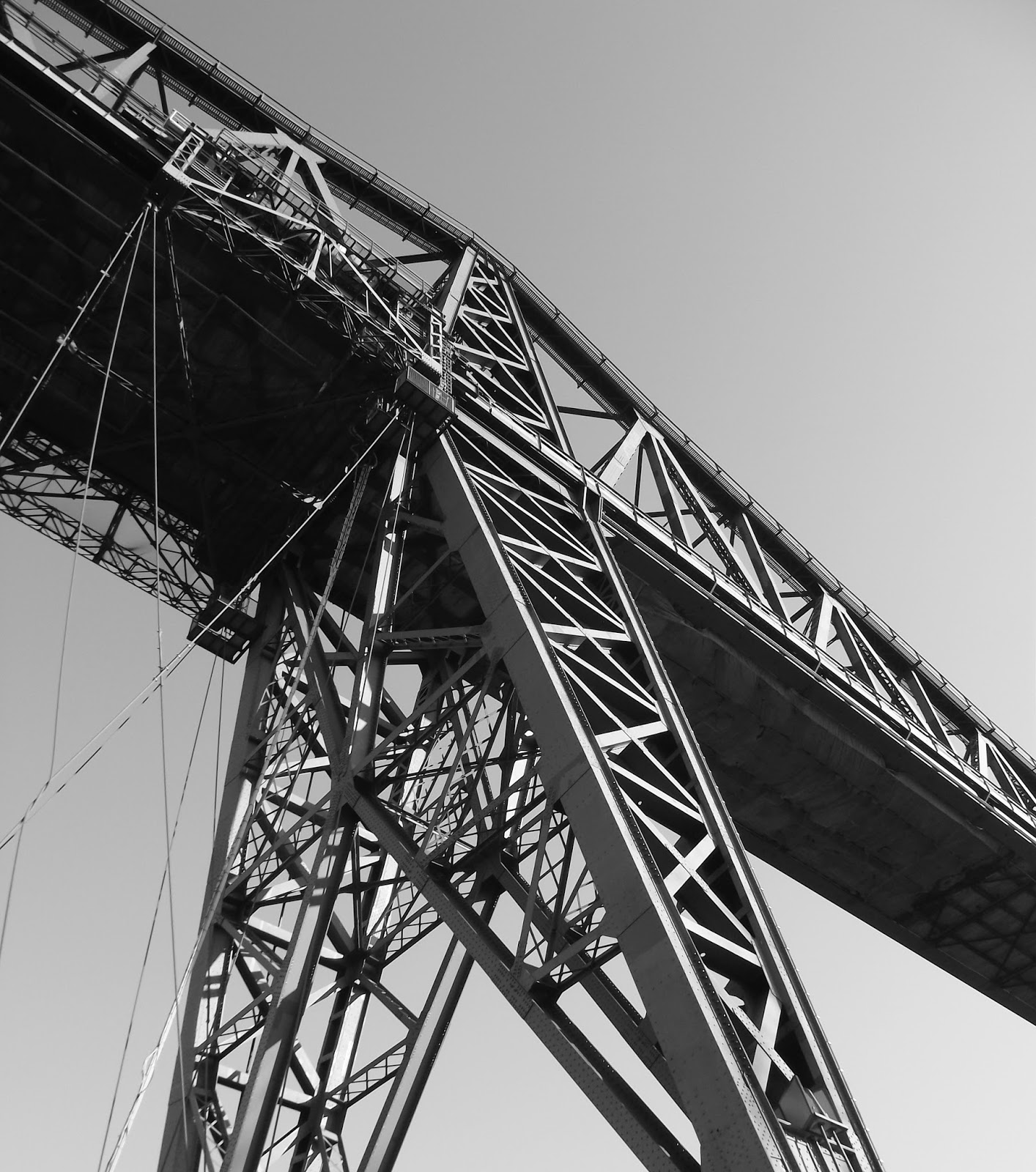
Built of iron, it has a span of 525 feet, with towers 200 feet high and of 100 tons each, braced by cables that run parallel to the River Nervión. The original boom, gondola and traction gear weighed in at a further 400 tons. The bridge is joined together by 21,401 bolts and 10,629 rivets. The tower on the Las Arenas side housed a coal lift.
The truss was dynamited on 17 June 1937, during the Spanish Civil War, but service recommenced in June 1941, with a lighter boom and larger but lighter gondola. The bridge received in November 1998 its fifth gondola. This hangs from a 36-wheel trolley, is 82 feet long, and can carry six cars and 200 people at a time (bottom).
Still very much in use, operating every eight minutes during the day, every hour during the night, the journey taking just 90 seconds, the bridge is integrated into the ticketing for Bilbao's wider public transport system. Until 1999, except for a period 1941-45 when controlled from the gondola, it was operated from a booth up on the boom (above).
The 1998 overhaul included construction of ground-level waiting rooms and an enclosed walkway, with lifts at both ends, that enables one to walk across the river at about 147 feet above high water level (above). Known locally as the Puente Colgante, the Hanging Bridge, this world first was declared by UNESCO in July 2006 a World Heritage Site.
14 March 2016
Echo of an Ekco
The cabinet of Ekco's AC-only AC77, designed by Serge Chermayeff, was available in both walnut Bakelite, and black Bakelite with a front panel and controls in ivory urea formaldehyde. Also available were AC/DC (AD77), battery (B67) and accumulator/vibrator (BV67) versions.
This working example of the black and ivory AC77 is doubly rare, in that it was manufactured, in 1936, at Ekco's short-lived Belgian factory, in Haren, near Brussels. Accordingly, the set uses French side-contact valves.
The Belgian operation was started in 1935 to counter the effect of continental import duties, levied by weight, but closed in 1937 for economic reasons. A sales and service function remained at Haren until the start of WWII. The back is branded differently from Southend-on-Sea-built Ekcos.
This working example of the black and ivory AC77 is doubly rare, in that it was manufactured, in 1936, at Ekco's short-lived Belgian factory, in Haren, near Brussels. Accordingly, the set uses French side-contact valves.
The Belgian operation was started in 1935 to counter the effect of continental import duties, levied by weight, but closed in 1937 for economic reasons. A sales and service function remained at Haren until the start of WWII. The back is branded differently from Southend-on-Sea-built Ekcos.
Labels:
Design,
Ekco,
Vintage Technology
04 March 2016
17 February 2016
Rendsburg Transporter Bridge, Schleswig-Holstein
The Rendsburg High Bridge was the last of the three transporter bridges built in Germany: Osten opened in 1909 and remains in use, Kiel opened in 1910 but was demolished in 1923, and Rendsburg opened in 1913 and remains in use.
Designed by Friedrich Voss, construction began in 1911. The bridge was, and is, unique, in that it is properly a railway viaduct, carrying the Neumünster-Flensburg line over the Kiel Canal. From the central bridge (above) is slung a gondola such that the structure doubles as a transporter bridge.
Because the bridge carries a railway, a maximum incline of 1:150 was required. Accordingly, the whole structure is about 4.7 miles long, including the approach embankments. The trussed steel viaduct (first and last photos) boasts a total length of 8,156 feet, an incredible 1.5 miles.
The cantilevered central bridge is 966.5 feet long and has a main span of 459 feet. The towers are 164 feet high, and the bridge provides clearance above the canal water of 138 feet. A design quirk of the viaduct is that on the north side of the canal the 360-degree Rendsburg Loop carries the railway down to Rendsburg Station, at ground level.
The transporter bridge operates daily, making it one of just seven bridges worldwide still operating in transporter form. The journey between Osterrönfeld and Rendsburg takes just 90 seconds, and is repeated every quarter of an hour.
Regrettably, the gondola, which can carry four cars, but is largely used by pedestrians and cyclists, was in January 2016 struck by a cargo ship and badly damaged (above). At the time of writing, the transporter bridge was as a result not operating.
Osten Transporter Bridge, Lower Saxony
Osten Transporter Bridge was built 1908-09 to provide a crossing between Osten and Hemmoor that did not interfere with shipping on the River Oste. It is one of only 19 transporter bridges ever built to completion worldwide, and was the first of three in Germany: Osten (in use), Kiel (opened 1910, dismantled 1923), and Rendsburg (in use).
With a span of 259 feet, and a width of 32 feet, the bridge is of truss construction. The structure is symmetrical but for the overhang on the Osten side of the river (below).
Unusually for a transporter bridge, the gondola (next two photos) is suspended from the moving trolley by way of solid steel latticework, instead of the usual cables. Large compared to the modest scale of the bridge, the gondola can transport either 100 people or six cars at a time.
The foundations were laid by a local constructor, and the steelwork was fabricated by MAN (Maschinenfabrik Augsburg-Nürnberg) at Gustavsburg. AEG (Allgemeine Elektricitäts-Gesellschaft) of Berlin undertook the work to provide electric traction, as in a tram.
The bridge operated on a regular basis until 1974. It was listed as a Technical Monument in 1975. Taken out of service in 2001 because of extensive rust damage, the bridge was recommissioned in 2006.
Now operated as a tourist attraction from April to October, Osten is one of only nine survivors from the 19, and of only seven transporter bridges still operational in their original form. A small museum devoted to the bridge can be found on the Osten side.